
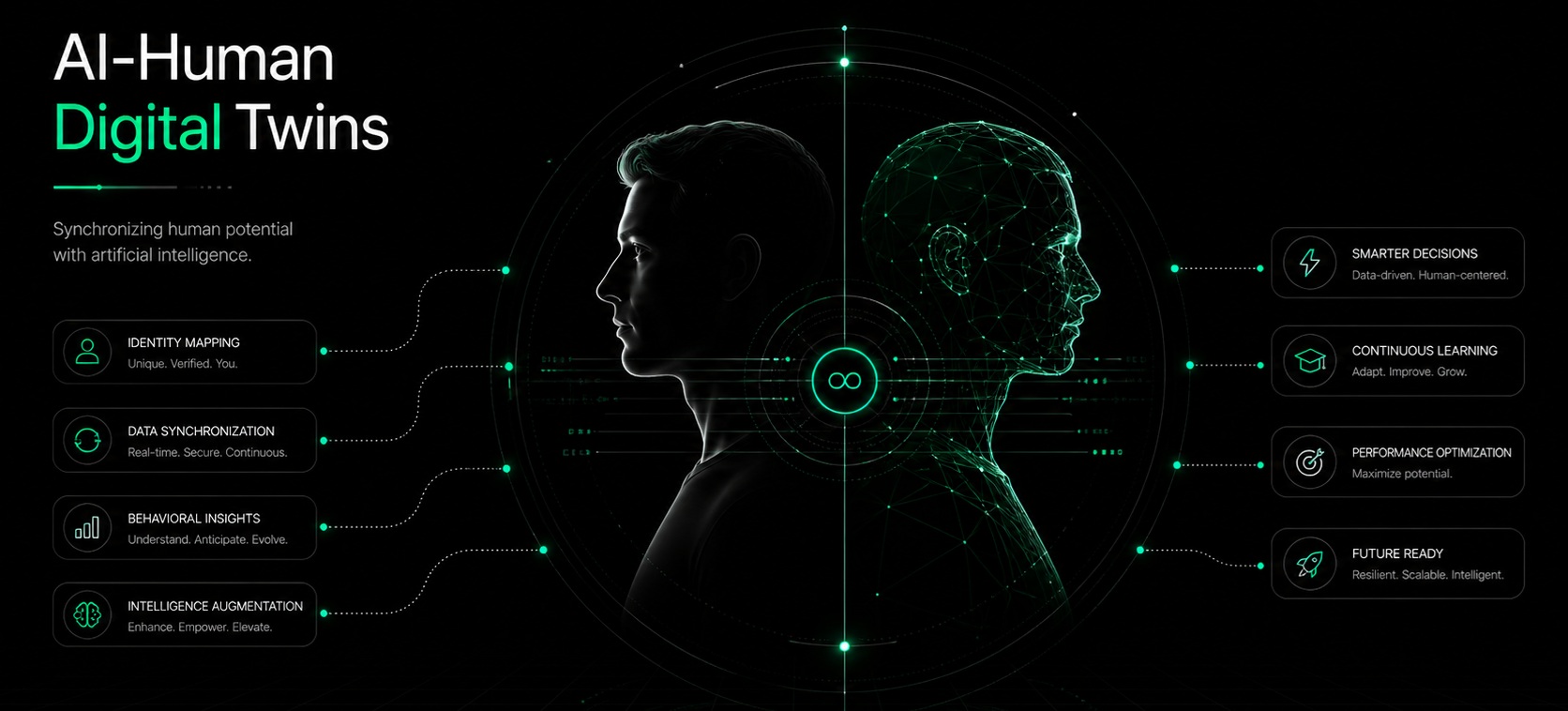
The Rise of the AI-Human
Digital Twin…
Researchers describe this as an emerging field that fuses sensing, modelling, artificial intelligence, and human-centred design. The field is young. Universal frameworks do not yet exist. But the direction is clear. The future is not AI that becomes human. It is human life surrounded by intelligent models of who we are, who we may become, and which small actions might alter our course.
2030
The core challenge will be delegation. Can it spend your money? Cancel your meeting? Send a message in your voice? The first failures will be quiet but costly: the wrong bill paid, the wrong tone sent, the wrong risk inferred from incomplete data.
That is why the 2030 twin must have clear permission layers, action logs, approval thresholds, and instant revocation. The research is advancing. The risk is letting convenience become invisible control.
2040
It may flag burnout three weeks before you feel it. It may spot the convergence of poor sleep, terse messages, packed calendars, and skipped workouts. It may recommend rest, early intervention, or social support before you ask. The risk is soft control. The machine will not command you. It will simply make alternative choices look irrational, unsafe, or statistically inferior. When the model sees consequences better than you do, recommendation becomes power. You remain free on paper. You follow its forecasts in practice.
2050
realism
By 2040, AI models you.
By 2050, AI extends you.
Further Reading
Digital twins for health: A scoping review
Journal: npj Digital Medicine
https://www.nature.com/articles/s41746-024-01073-0
This review examines how digital twins are being applied in healthcare, including disease modelling, patient-specific prediction, and treatment planning. It is useful for grounding the article’s argument that healthcare is likely to be one of the first serious domains for human digital twin development.
–
Artificial intelligence in digital twins
Journal: Data & Knowledge Engineering
https://www.sciencedirect.com/science/article/pii/S0169023X24000284
This paper reviews how AI is being integrated into digital twin systems across multiple domains. It supports the article’s claim that future digital twins will rely on AI for prediction, simulation, optimisation, and decision support.
Human digital twin: A survey
Journal: Journal of Cloud Computing: Advances, Systems and Applications
https://link.springer.com/article/10.1186/s13677-024-00691-z
This survey provides a broad overview of human digital twin research, including definitions, technologies, applications, and challenges. It is one of the most directly relevant sources for explaining what a human digital twin is and why the field is still emerging.
–
Human Digital Twin in the context of Industry 5.0
Journal: Robotics and Computer-Integrated Manufacturing
https://www.sciencedirect.com/science/article/abs/pii/S0736584523001011
This article connects human digital twins with Industry 5.0, where human-centred design, safety, wellbeing, and human-machine collaboration are central. It is useful for positioning the digital twin as more than automation: a system designed around human agency and interaction.